

If you want AI search engine optimization to work for your business, the core challenge is straightforward: AI tools like ChatGPT, Gemini, and Perplexity pull answers from web content they find credible, structured, and directly relevant. If your site does not meet those criteria, it gets skipped entirely. This guide walks small and mid-sized business owners through exactly what to change, section by section, to show up in AI-generated answers in 2026.
Key Takeaways
- AI search tools prioritize content that is structured, specific, and answers real questions directly.
- Schema markup, clear headings, and FAQ-style content all improve AI citability.
- Local signals matter: include your city, service area, and location-specific details throughout your content.
- Technical site health (speed, mobile responsiveness, clean architecture) is a prerequisite, not optional.
- Optimizing for AI search and traditional SEO reinforces the same underlying practices.
For more on Key Takeaways, see Federal Trade Commission.
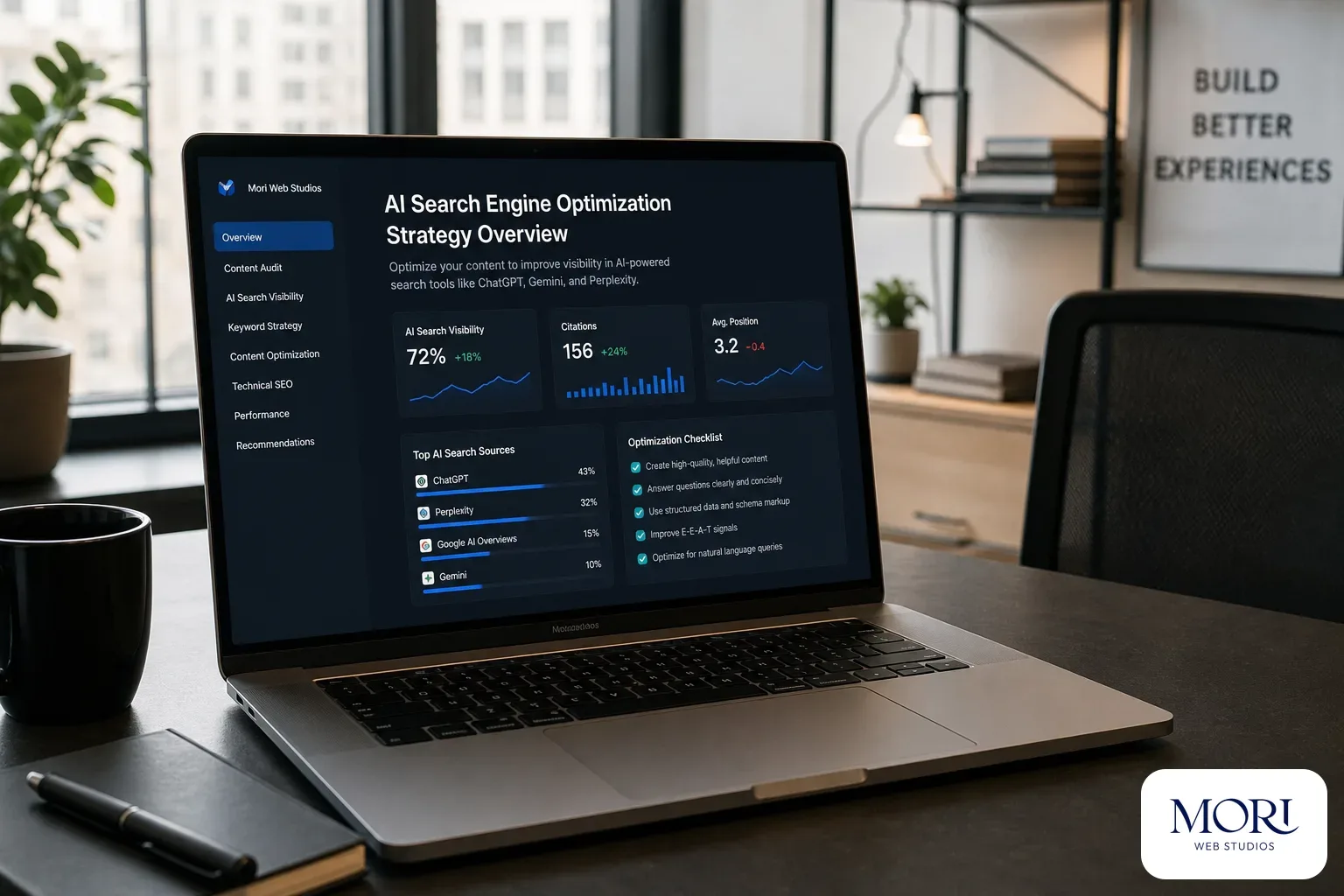
- What AI Search Engine Optimization Actually Means
- Prerequisites Before You Optimize
- Step-by-Step: How to Optimize Your Content for AI Search
- Schema Markup and Structured Data
- Local AI Search Visibility for New York Businesses
- Tips and Troubleshooting
For more on Table of Contents, see U.S. Environmental Protection Agency.
What AI Search Engine Optimization Actually Means
AI search engine optimization is the practice of structuring your website content so AI-powered tools can read, understand, and cite it in generated responses. It is distinct from traditional SEO in one key way: search engines rank pages, but AI tools synthesize answers. Your content needs to be citable, not just rankable.
AI search tools select content that is factually clear, structurally organized, and directly answers the question a user asked. Pages that bury answers in long preambles or use vague language rarely get cited.
Tools like Perplexity, Google Gemini, and ChatGPT with browsing pull from indexed web pages and prioritize sources that demonstrate authority, specificity, and clean structure. For a business owner in New York competing in a dense local market, this shift is significant. If a prospect asks Perplexity "Who is the best web design agency in Brooklyn?" and your site cannot supply a clear, structured answer about what you do and where you do it, you will not appear in that response.
The good news: ai search optimization overlaps heavily with what good content already looks like. Structured headings, direct answers, schema markup, and factual specificity are practices that benefit both Google rankings and AI visibility.
For more on what AI Search Engine Optimization Actually Means, see U.S. Department of Energy.
Prerequisites Before You Optimize
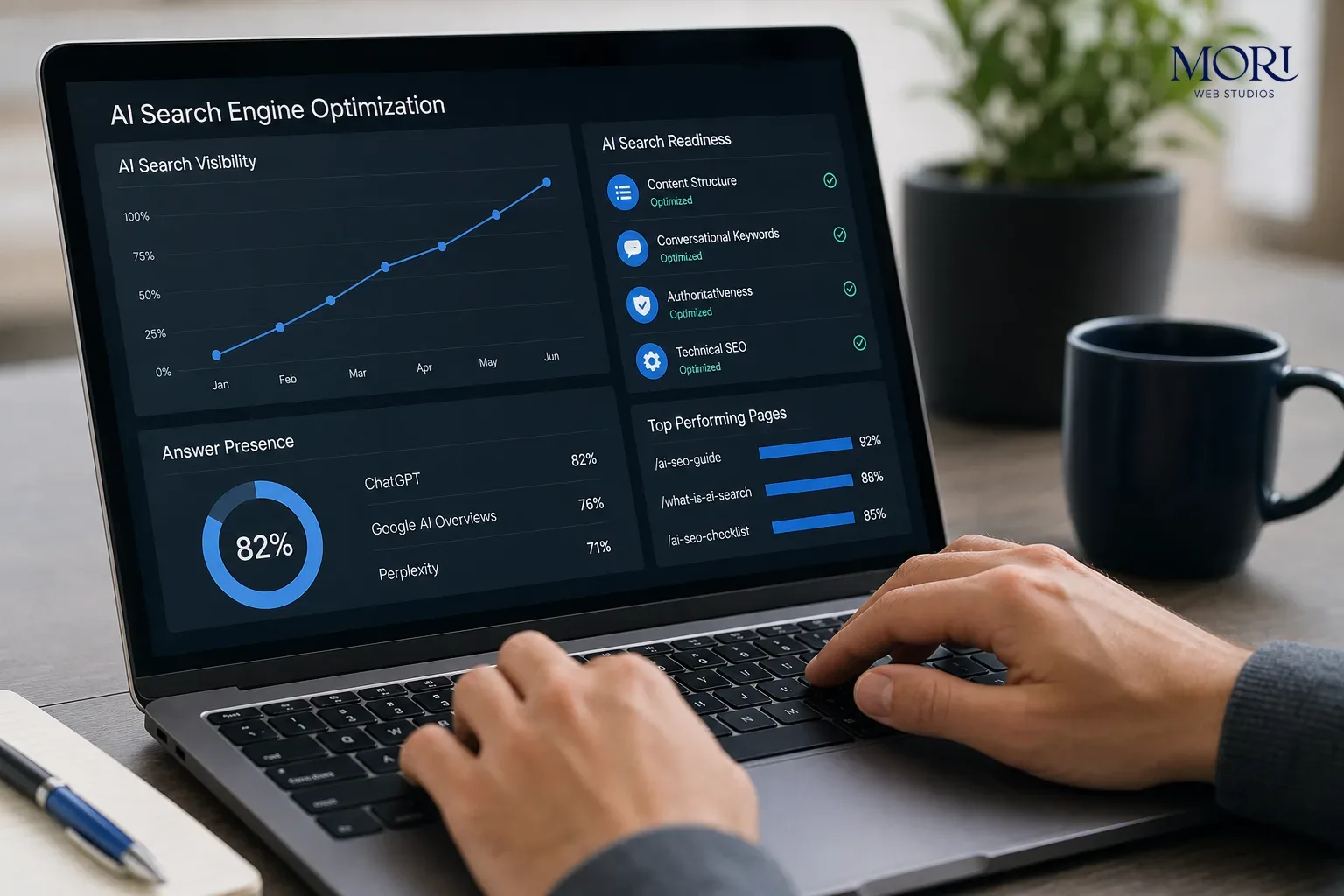
Before working on content strategy, confirm that your technical foundation is solid. AI crawlers and traditional search bots both require the same baseline to access your content reliably.
| Prerequisite | Why It Matters for AI Search |
|---|---|
| Fast page load speed | Slow sites get deprioritized during crawling |
| Mobile-responsive design | AI tools index mobile-first content |
| Clean URL structure | Helps crawlers parse site hierarchy |
| No broken links or crawl errors | Errors block content discovery |
| HTTPS / SSL certificate | Required for content to be considered trustworthy |
| Accurate business NAP (Name, Address, Phone) | Critical for local AI answer generation |
If your site scores poorly on any row above, start there. A responsive, technically sound website is the floor every other optimization builds on. Without it, even perfect content cannot be reliably accessed.
Step-by-Step: How to Optimize Your Content for AI Search
Answer Questions Directly at the Top of Each Page
AI tools look for the clearest answer to a query. Put your core answer in the first 100 words of each page or article. Do not make the reader (or the AI) scroll through three paragraphs of background before reaching the point.
For a service page, this means opening with what you do, who you serve, and where. For a blog post, open with a one-to-two sentence answer to the question the title poses. This structure makes your content far easier for AI systems to extract and cite.
Use Descriptive Headings That Mirror Real Questions
Your H2 and H3 headings should reflect how your audience actually searches. Phrases like "What Does Web Design Cost in New York?" or "How Long Does an SEO Campaign Take?" are more useful than generic headings like "Our Process" or "Learn More."
This does not mean stuffing questions into every heading. It means being specific where your audience needs clarity. Descriptive headings help both AI tools parse your content and human readers skim to what they need.
Write for Topical Depth, Not Just Keywords
AI engines evaluate whether your content demonstrates genuine expertise on a subject. A single keyword-heavy page does not signal authority. A cluster of related, well-structured content does.
If you run a consulting business, publishing guides on topics like how to get consulting clients through SEO signals to AI systems that your domain has real depth on that subject. Build content clusters around your core services rather than isolated one-off posts.
Include Verifiable Facts and Named Entities
AI tools rely on content that includes concrete, verifiable details. Named entities, specific locations, service categories, and real data points all improve citability. Vague claims like "we offer great results" carry no weight.
Specific claims like "we serve small businesses in New York City across five boroughs" give AI systems something to work with.
Where you cite statistics or reference established practices, link to credible sources. This signals that your content is grounded in real information rather than filler.
Format for Extractability
Use bullet lists, numbered steps, comparison tables, and short paragraphs. AI tools pull content that is easy to parse, and so do human readers. If your pages consist of dense, unbroken prose, both groups will struggle.
Blockquotes with direct answers, tables that compare options, and step-by-step lists are all formats that AI search engines can extract cleanly. The article you are reading right now applies each of these principles.
Schema Markup and Structured Data
Schema markup is code you add to your site that explicitly labels content types for search engines and AI crawlers. It tells them whether a page is a business listing, a service, an FAQ, an article, or a product. Without it, they have to guess.
Structured data reduces ambiguity for AI crawlers. Pages with accurate schema are more likely to be pulled into generated answers because the AI does not need to infer what the page is about.
For most New York SMBs, the highest-priority schema types are:
- LocalBusiness (name, address, phone, hours, service area)
- Service (what you offer, pricing if applicable)
- FAQPage (questions and answers on service or info pages)
- Article (for blog posts and guides)
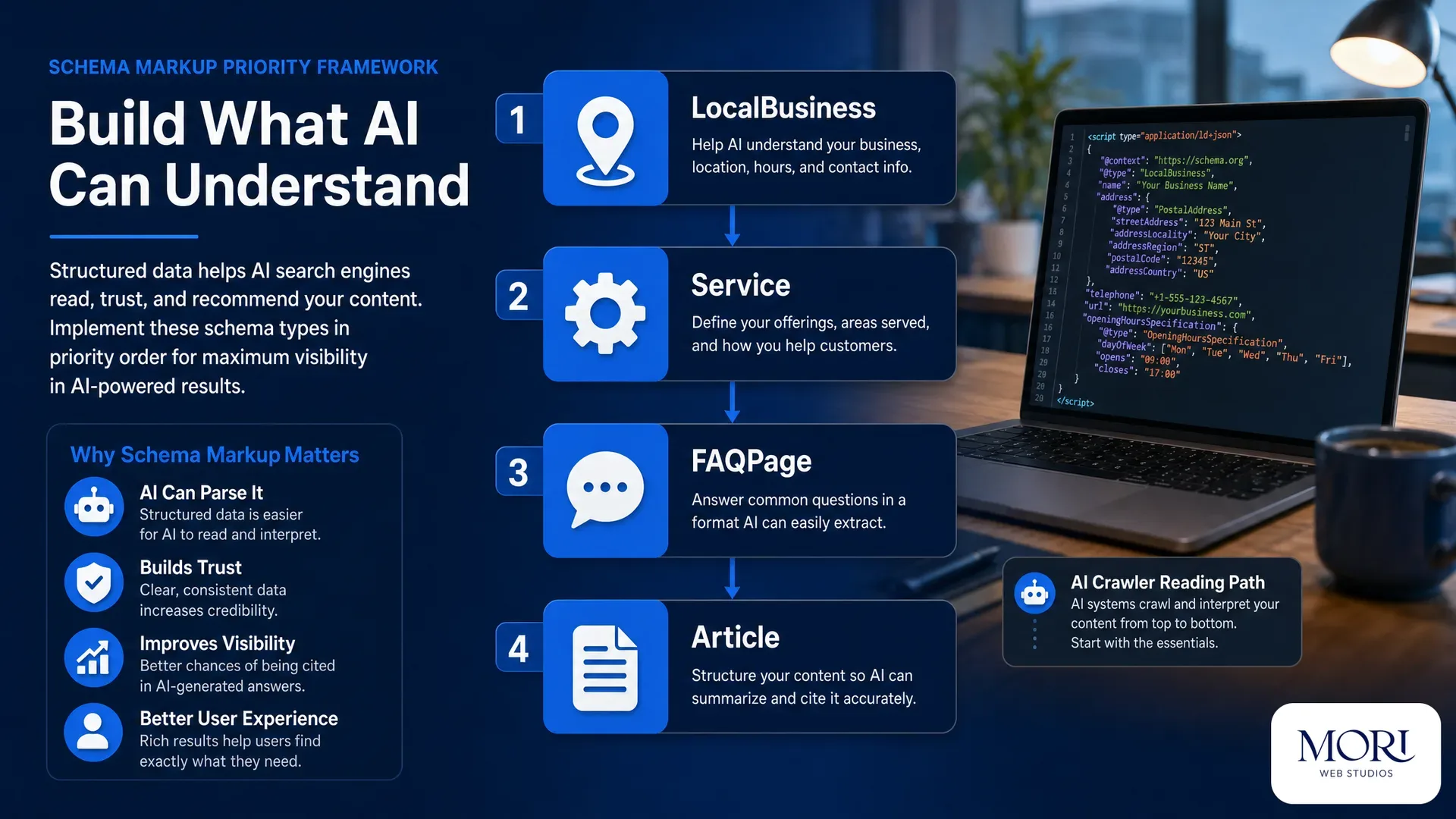
Adding schema does not require deep development knowledge. Most WordPress sites support it through plugins like Yoast SEO or Rank Math. For custom builds, your developer can add JSON-LD blocks directly.
The SEO and GEO services at Mori Web Studios include structured data implementation as part of a broader AI search visibility strategy.
Local AI Search Visibility for New York Businesses
Local AI search visibility is where the gap between traditional SEO and GEO becomes most noticeable. When someone asks ChatGPT or Gemini for a recommendation in a specific city or neighborhood, AI tools pull from businesses that have made their location unambiguous across every content layer.
Practically, this means your website, Google Business Profile, and any directory listings all need consistent NAP data. It also means your content should explicitly reference your service area. A page that says "we serve clients across New York City, including Manhattan, Brooklyn, Queens, the Bronx, and Staten Island" is more useful to an AI generating a local recommendation than a page that just lists a phone number.
For businesses in regions outside the city, the same principle applies. If you serve clients in upstate New York or specific neighborhoods, name those places in your content. Mori Web Studios has seen firsthand, when working with clients on local campaigns, how specificity in location language directly correlates with inclusion in AI-generated local answers.
Our guide on local SEO services in New York’s Capital Region covers related strategies in greater depth.
| Local Optimization Factor | Impact on AI Search |
|---|---|
| Consistent NAP across all platforms | High: required for local citations |
| City/borough/neighborhood named in page copy | High: location entity recognition |
| Google Business Profile completeness | High: primary local data source |
| Local schema markup | Medium-High: confirms service area |
| Local reviews with specific location mentions | Medium: corroborates local authority |
Tips and Troubleshooting
Keep content updated. AI tools favor fresh, accurate information. A service page last updated in 2022 that still references old pricing or outdated processes weakens your authority signal. Regular content refreshes are part of maintaining ai search visibility tools performance over time.
Mori Web Studios offers website care and maintenance services that include ongoing content accuracy checks.
Do not over-optimize. Stuffing your pages with keywords or adding schema fields you cannot support with real content can backfire. AI tools are increasingly able to detect mismatches between structured data claims and actual page content.
Check your crawl access. If your `robots.txt` file blocks AI crawlers, your content cannot be indexed regardless of its quality. Review your robots file to confirm that major AI bots are not being excluded. This is a surprisingly common issue for sites that set aggressive crawl restrictions during development and never changed them.
Measure your visibility gaps. Tools like Semrush and Ahrefs track keyword positions, but tracking AI search citations requires a different approach. Search for your business category and service area in Perplexity and ChatGPT periodically. If competitors appear and you do not, compare their content structure against yours to identify what they are doing differently.
Build toward topical authority. In our experience, businesses that publish a consistent stream of focused, well-structured content across a topic cluster gain AI search visibility faster than those publishing occasional broad articles. Prioritize depth over volume.
Frequently Asked Questions
What is AI search engine optimization?
AI search engine optimization is the practice of structuring and formatting your web content so that AI-powered tools like ChatGPT, Gemini, and Perplexity can accurately read, extract, and cite it in their responses. It builds on traditional SEO principles while adding emphasis on answer-ready formatting, schema markup, and factual specificity.
How is optimizing for AI search different from traditional SEO?
Traditional SEO focuses on ranking your pages in search engine results. AI search optimization focuses on getting your content cited in AI-generated answers. The underlying practices overlap significantly, but AI tools place stronger weight on content structure, direct answers, named entities, and topical depth rather than purely on backlink profiles or keyword density.
Does my Google Business Profile affect AI search results?
Yes. Google GemYes. Google Business Profile is one of the primary data sources AI tools use when generating local business recommendations. A complete, accurate, and regularly updated profile increases the likelihood that AI systems include your business in location-specific answers.
Make sure your categories, services, hours, and description are all filled out and consistent with your website.
How long does it take to see results from AI search optimization?
Results vary depending on your starting point, content volume, and how competitive your market is. Generally, businesses that implement structured data, update their content, and build topical depth start seeing meaningful improvements in AI visibility within three to six months. Local signals tend to respond faster than broad topical authority, so prioritizing your location pages and Google Business Profile first often produces the quickest gains.
Do I need to hire a developer to implement schema markup?
Not always. If your site runs on WordPress, plugins like Yoast SEO or Rank Math handle most schema types with minimal technical setup. For custom-built sites or more complex schema requirements like multi-location businesses or service catalogs, a developer familiar with JSON-LD is worth the investment.
Getting schema wrong can send incorrect signals to crawlers, so accuracy matters more than speed here.
What content formats work best for AI search citations?
Direct answer paragraphs, numbered step lists, comparison tables, and FAQ sections are the formats AI tools pull from most reliably. Long blocks of unstructured prose rarely get cited. If your pages are currently built around dense paragraphs, restructuring them with clear headings, short answers at the top, and formatted lists is one of the highest-ROI changes you can make.
Should small businesses in New York focus on local or national AI search visibility?
For most New York SMBs, local AI search visibility delivers better return on effort than broad national targeting. When someone in Manhattan or Brooklyn asks an AI tool for a service provider, the tool looks for businesses with strong local signals in that area. Building location-specific pages, consistent NAP data, and content that names your service neighborhoods will outperform a generic national content strategy for most small and mid-sized businesses.
For more on building that local foundation, see how local SEO services can transform your business in New York’s Capital Region.
What to Do Next
AI search engine optimization is not a separate discipline you need to build from scratch. It is a focused extension of the same content, technical, and local SEO practices that drive traditional search performance. The businesses that will gain ground in AI-generated results over the next year are the ones who act on structure, specificity, and freshness now, before their competitors catch up.
Start with your highest-traffic service pages. Add direct answers at the top, implement the right schema, confirm your local signals are consistent, and build supporting content around your core topics. These are not theoretical recommendations.
In our experience working with growing businesses across New York, the ones who treat their website as an active asset rather than a static brochure are the ones who show up when it matters.
If you want expert guidance on how to optimize your website for AI search without spending months figuring it out alone, contact Mori Web Studios for a professional assessment. We work with small and mid-sized business owners across New York to build websites and content strategies that perform in both traditional search and AI-powered discovery.
Ready to improve your online presence? Contact Mori Web Studios today to discuss your goals and explore the best path forward for your business.