

Search engine optimization for consultants is defined as the practice of positioning your expertise in front of buyers who are actively evaluating vendors, not just browsing for information. Getting consulting clients through SEO works when you build trust architecture around your specific practice area, not when you chase traffic volume. Buyer vendor evaluation queries convert at 5 to 8 times higher rates than general traffic queries. That single fact should reshape every content decision you make. Tools like Ahrefs, Google Search Console, and LinkedIn are the execution layer, but Google’s E-E-A-T framework (Experience, Expertise, Authoritativeness, Trustworthiness) is the foundation that determines whether qualified prospects trust you enough to reach out.
What SEO strategies actually work for consultants to attract clients?
The most effective SEO strategy for consultants centers on niche positioning, not broad visibility. Niche-specific content yields 3.1 times higher qualified lead rates than broad keyword strategies. That gap exists because a CFO searching for “cash flow restructuring for mid-market manufacturers” is far closer to hiring than someone searching “business consultant.”
Focus on practice area plus industry intersection keywords. Instead of targeting “management consulting,” target “supply chain consulting for food and beverage companies” or “HR transformation for healthcare systems.” These intersections map directly to how buyers search when they are ready to evaluate vendors. The specificity signals that you understand their world before they even contact you.

Develop scenario-based content rather than service descriptions. A page titled “Our Consulting Services” tells a prospect nothing they cannot find on a hundred other sites. A page titled “How We Help Private Equity Portfolio Companies Reduce Integration Costs in the First 90 Days” answers a real question a real buyer types into Google. Scenario-based content also performs better in AI-generated search summaries, which now influence a significant share of research-stage decisions.
Publish partner-attributed thought leadership. Articles co-authored with recognized industry figures or published on platforms like Forbes, Harvard Business Review, or industry association sites carry external authority signals that your own domain cannot generate alone. Thought leadership content compounds over time, continuing to generate qualified leads for years after publication.
Implement schema markup, specifically JSON-LD. FAQ schema increases snippet eligibility and click-through rates, and it positions your content as a citation source for AI Overviews. This matters because 83% of AI Overview searches end with no traditional click, yet AI referrals convert 3 to 4 times better than standard organic visits. Being cited by an AI answer is now a lead generation event, not just a visibility metric.
Pro Tip: Promote every article you publish via a LinkedIn post and a short email to your existing network within 48 hours of going live. Distribution amplifies the authority signal and accelerates the time it takes Google to index and rank new content.
How to structure your consulting website for maximum SEO impact
Website architecture for consulting firms follows a different logic than e-commerce or media sites. Site structures aligned with buyer search patterns outperform generic sites by an order of magnitude. The goal is to make it obvious, within seconds, that you solve a specific problem for a specific type of client.
Practice area and industry intersection pages
Build dedicated pages for each combination of what you do and who you serve. A strategy consulting firm might create separate pages for “strategy consulting for SaaS companies,” “strategy consulting for healthcare organizations,” and “strategy consulting for family-owned businesses.” Each page should open with a specific problem statement, not a generic capability description. This architecture also creates natural internal linking clusters that signal topical authority to Google.
Partner and team bio pages
These pages are underused assets. A bio page optimized with ProfessionalProfile schema, external publication mentions, and links to authored content functions as a trust signal for both search engines and prospective clients. When a buyer searches your name after reading your article, a well-structured bio page closes the credibility gap faster than any sales call.
Conversion pathways that actually convert
The difference between a consulting site that generates leads and one that does not usually comes down to conversion architecture. Top consulting firms convert 4.7% of organic visitors into leads versus the 0.9% industry average. That gap is not explained by traffic. It is explained by clear next steps, diagnostic offers (“Schedule a 30-minute diagnostic call”), and credible social proof placed at the moment of decision.
| Element | Low-converting site | High-converting site |
|---|---|---|
| Call to action | “Contact us” | “Schedule a free diagnostic call” |
| Social proof | Logo wall | Named client outcomes with metrics |
| Content depth | 500-word service pages | 1,500+ word scenario-specific articles |
| Schema markup | None | JSON-LD with FAQ and ProfessionalProfile |
| Internal linking | Minimal | Topical clusters with clear hierarchy |
Pro Tip: Keep competitive topic pages at 1,500 words or more. Google consistently ranks longer, more specific content above thin pages for high-intent consulting queries because depth signals genuine expertise.
Step-by-step process to implement SEO and get consulting clients
Execution separates consultants who talk about SEO from those who generate leads from it. Follow this sequence to build a system that compounds over time.
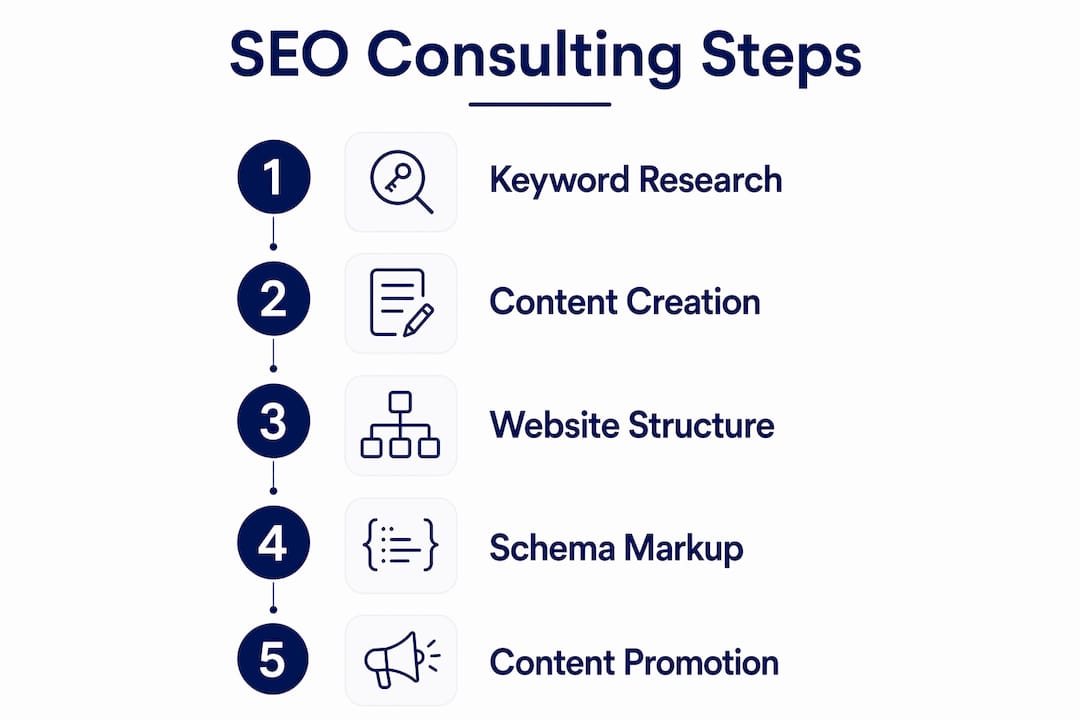
- Research long-tail keywords using Ahrefs or Google Search Console. Filter for queries that combine your practice area, a specific industry, and a problem or outcome. Prioritize keywords with clear buyer intent over high search volume.
- Analyze the top three ranked pages for each target keyword. Identify what they cover, what they miss, and where your direct experience gives you a credibility advantage. Coverage gaps are your content opportunities.
- Write scenario-specific articles with a clear call to action in every piece. Each article should address one specific client situation, include named examples or anonymized case data, and end with a direct invitation to schedule a conversation.
- Add JSON-LD schema markup to every page. Use Google’s Rich Results Test to validate that your structured data is error-free before publishing. Errors in schema markup disqualify pages from rich result eligibility.
- Promote each article via LinkedIn and email within 48 hours. Consistent distribution builds the external signal pattern that Google uses to assess authority. One well-promoted article outperforms ten unpromoted ones.
- Update and A/B test your content and conversion elements quarterly. Continuous content improvement is what separates sites that plateau from sites that compound. Test your call-to-action copy, your diagnostic offer framing, and your social proof placement every 90 days.
| Phase | Action | Tool |
|---|---|---|
| Research | Identify long-tail buyer intent keywords | Ahrefs, Google Search Console |
| Creation | Write 1,500+ word scenario-specific articles | Google Docs, your CMS |
| Technical | Validate JSON-LD schema markup | Google Rich Results Test |
| Promotion | Distribute via LinkedIn and email | LinkedIn, email platform |
| Optimization | Update content and test conversion elements | Hotjar, Google Analytics 4 |
Pro Tip: Track leads by content source from day one. Knowing which articles generate actual inquiries, not just traffic, tells you exactly where to invest your next 10 hours of content work.
Common pitfalls consultants face when trying to attract clients via SEO
Most consulting SEO efforts fail not because of poor execution but because of the wrong diagnosis. Doubling content output without addressing authority gaps or conversion architecture yields little measurable impact. Avoid these specific mistakes.
- Optimizing for traffic volume instead of trust architecture. A consulting site with 500 monthly visitors and a 4% conversion rate outperforms one with 5,000 visitors and a 0.3% rate. Prioritize the quality of the audience and the clarity of your credibility signals over raw traffic numbers.
- Ignoring vendor evaluation stage queries. Buyers searching “top supply chain consultants for automotive manufacturers” or “how to evaluate an HR consulting firm” are in active selection mode. These queries are lower volume but dramatically higher intent. Most consultants skip them entirely because the search numbers look small.
- Neglecting conversion optimization on the website itself. Getting a prospect to your site is only half the job. If your site lacks a specific offer, named client results, or a frictionless next step, the traffic investment is wasted. Conversion architecture is not a design preference. It is a revenue decision.
- Over-generalizing keywords and content topics. Broad keywords like “business strategy” or “leadership consulting” attract researchers, not buyers. The more specific your content, the more it self-selects for prospects who already recognize they need exactly what you offer.
- Failing to account for AI search dynamics. AI-assisted content production accelerates niche dominance but must be paired with genuine expertise to meet Google’s E-E-A-T requirements. AI-generated content without expert review fails the trust test that consulting buyers apply before they ever contact you.
Key takeaways
Consulting SEO succeeds when you align content, site structure, and conversion pathways with the trust signals buyers need at the vendor evaluation stage, not when you maximize traffic.
| Point | Details |
|---|---|
| Target buyer intent keywords | Focus on practice area plus industry intersection queries that signal active vendor evaluation. |
| Build trust architecture first | E-E-A-T signals and conversion pathways matter more than traffic volume for consulting lead generation. |
| Use schema markup consistently | JSON-LD with FAQ schema improves rich result eligibility and positions content for AI citation. |
| Publish scenario-specific content | Niche content generates 3.1 times more qualified leads than broad keyword strategies. |
| Promote and update continuously | Regular distribution and quarterly content updates compound authority and conversion rates over time. |
Why most consulting SEO advice misses the point
I have reviewed dozens of consulting websites that rank reasonably well but generate almost no leads. The pattern is consistent: the content is competent, the keywords are present, and the site looks professional. What is missing is specificity at the moment of decision.
The advice I see repeated most often, “publish more content,” treats SEO as a volume game. For consultants, it is a precision game. One article that speaks directly to a CFO evaluating restructuring options for a specific industry will outperform ten generic thought leadership pieces every time. I have watched this play out repeatedly. The consultants who win with SEO are the ones willing to narrow their focus until it feels almost uncomfortably specific.
The other thing most articles understate is patience. Consulting sales cycles run 60 to 180 days from first search to signed contract. SEO compounds on a similar timeline. The consultants who abandon their strategy after 90 days never see the return that was three months away. Track every lead back to its source, update your content based on what converts, and treat SEO as a long-term client acquisition system rather than a short-term traffic tactic.
— Jeanherline
How Mori Web Studios helps consultants attract clients online
Mori Web Studios builds SEO and web design systems specifically designed to help service providers and consultants generate qualified leads from search. From website design and SEO to conversion architecture and content strategy, the team at Mori Web Studios handles the technical and strategic work that turns your expertise into a client acquisition engine. If your consulting website is not generating consistent inquiries, the issue is almost always a combination of weak trust signals, thin content, and unclear conversion pathways. Mori Web Studios diagnoses exactly where the gap is and builds a plan to close it.
FAQ
What does SEO for consulting services actually mean?
SEO for consulting services means optimizing your website and content to appear in front of buyers who are actively evaluating vendors in your practice area. The focus is on trust signals and conversion, not raw traffic volume.
How long does it take to get consulting clients through SEO?
Most consulting SEO strategies take 6 to 12 months to generate consistent leads because consulting sales cycles are long and authority builds gradually. Targeting vendor evaluation stage keywords accelerates results by attracting buyers who are already close to a decision.
What keywords should consultants target for SEO?
Consultants should target long-tail keywords that combine a specific practice area, an industry, and a buyer problem or outcome. These queries convert at 5 to 8 times higher rates than broad, high-volume terms.
Does schema markup really help consulting websites rank better?
Yes. JSON-LD schema markup, validated through Google’s Rich Results Test, improves eligibility for featured snippets and AI Overview citations. Both increase visibility and drive higher-quality traffic than standard organic rankings alone.
How is AI search changing SEO for consultants?
AI Overviews now end 83% of searches without a traditional click, but AI referral traffic converts 3 to 4 times better than standard organic visits. Consultants should optimize content to be cited by AI answers, not just ranked in traditional results.