

Key Takeaways
- Systematic competitor website analysis reveals keyword gaps, design weaknesses, and missed local SEO opportunities you can act on immediately.
- Auditing competitor UX and page structure is as valuable as checking their keyword rankings.
- A focused SEO audit checklist applied to competitor sites saves time by showing you what already works in your market.
- Tracking your findings over time turns a one-time review into an ongoing strategic advantage.
- You do not need enterprise tools to do this well. Free and low-cost options cover most SMB needs.
Why This Matters Right Now
Search results have changed dramatically over the past two years. Google now surfaces AI Overviews, local packs, and structured snippets before organic blue links. If your competitors have optimized for those features and you have not, they are capturing attention you are not even competing for.

Competitive intelligence is not about copying your competition. It is about understanding what search engines and customers already reward so you can outperform it.
What Changed Recently
Local search has also tightened. A competitor ranking in your borough or city with a fully optimized Google Business Profile, locally cited pages, and consistent NAP (Name, Address, Phone) data will consistently outperform a site that skips those details, even if the competing site looks more polished.
What Readers Should Grasp First
You are not auditing competitor sites to replicate them. You are auditing to understand the gap between your current digital presence and what is already working for businesses targeting your same customers. That gap is your opportunity.
The checklist below structures that analysis so nothing important gets skipped.
For more on why This Matters Right Now, see U.S. Department of Energy.
Common Mistakes That Waste Time and Money
Most SMBs who try competitive intelligence without a framework end up collecting observations they never act on. They screenshot a competitor’s homepage, note that it looks better than theirs, and stop there. That is not an audit.
It is a comparison without context.
Planning Errors to Avoid
The most common planning mistake is auditing too many competitors at once. Pick two to four direct competitors in your local market, not industry giants in other cities. If you run a web design firm in the Bronx, you are not competing with a national agency in San Francisco.
Focus on the businesses ranking on page one of Google for your primary service keywords in your geographic area.
A second mistake is skipping mobile. Most local search happens on phones. If your competitor’s mobile site loads in under two seconds and yours takes five, that speed difference is costing you rankings regardless of your content quality.
Responsive design is not optional in 2026, and understanding what makes a website truly responsive gives you a clear standard to measure against.
Early Warning Signs
- Competitors outranking you for your own branded keywords
- Competitor pages appearing in Google’s AI Overviews for your service queries
- Competitors with more Google reviews and higher star ratings showing in the local pack
- Competitor blog content being cited by other local sites as reference material
How to Recover Quickly
If you are behind, start with the highest-authority page on a competitor’s site and ask: what does this page do that mine does not? Look at heading structure, word count, internal links, schema markup, and whether the page targets a specific local intent. These are fixable within days, not months.
Practical Improvements You Can Make Today
Audit Your Current Approach
A solid competitor website analysis covers four dimensions: SEO structure, design and UX, content depth, and local signals. Work through each in sequence rather than jumping around.
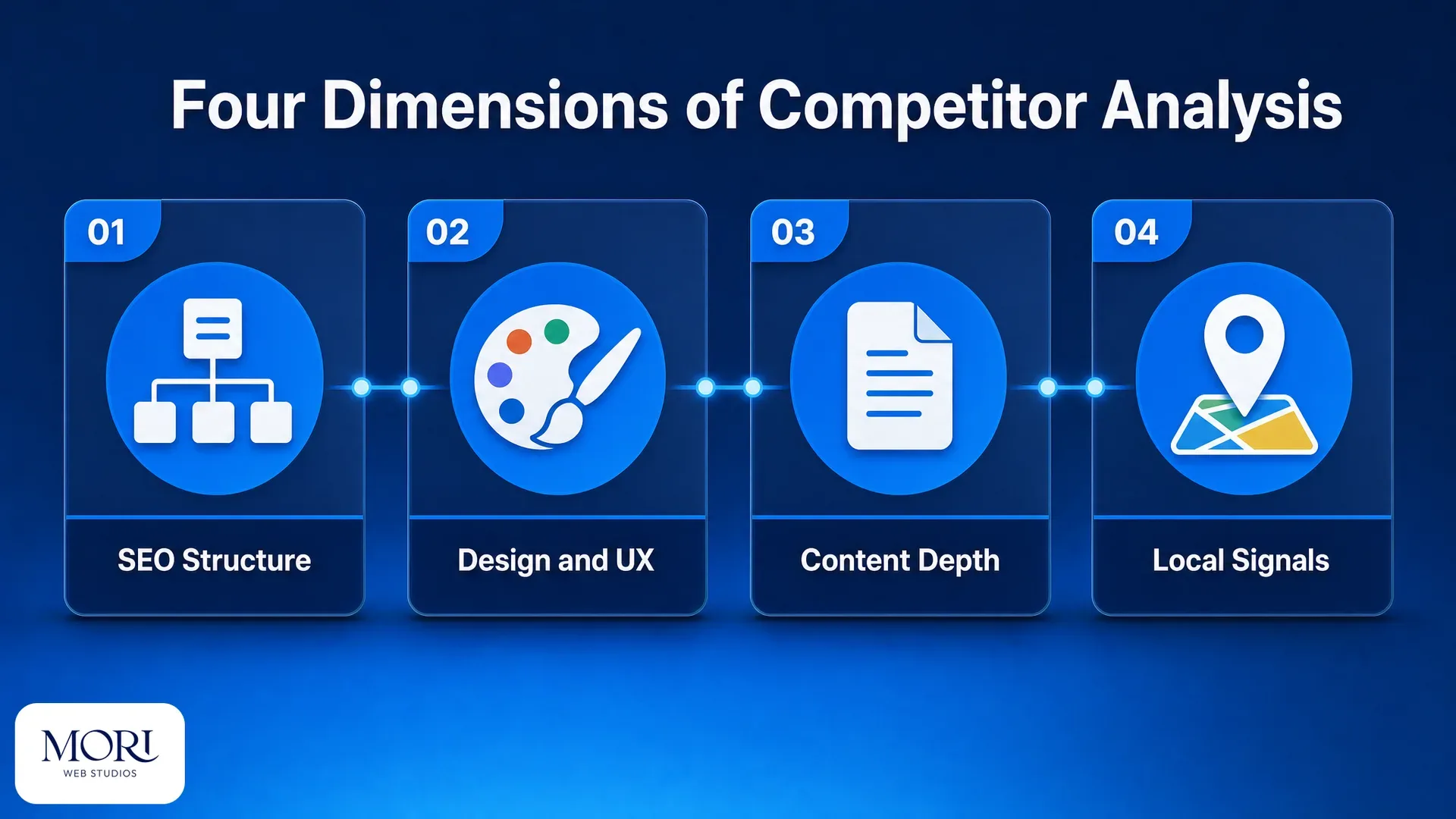
| Audit Area | What to Check | Free Tool |
|---|---|---|
| SEO Structure | Title tags, meta descriptions, H1-H3 hierarchy, schema | Google Search Console, Ahrefs Free |
| Content Depth | Word count, topic coverage, internal links | Screaming Frog (free tier) |
Work through this table for each competitor you are auditing. When working with clients in New York, our team has seen the biggest quick wins come from local signals and page speed. Those two areas are frequently neglected and easiest to fix.
Highest-Impact Fixes First
Once you have your findings, prioritize in this order:
- Core Web Vitals gaps. If a competitor’s page loads faster, Google notices.
- Thin content on service pages. If competitor pages average 900 words and yours average 300, that is a direct ranking disadvantage.
- SEO and GEO strategy
- Call-to-action clarity. Vague CTAs lose conversions. Competitors with specific, benefit-driven CTAs convert better.
How to Track Progress
Set a 90-day audit cycle. After each cycle, compare your rankings against the same competitor URLs you started with. Use Google Search Console to track impressions and clicks for your target keywords.
Document changes so you can attribute rank movement to specific actions.
Tools, Examples, and Proof Points
Workflows That Work
A practical workflow for a ux audit template applied to competitor sites looks like this:
- Open the competitor site on mobile.
- Time how long it takes to understand what the business does (target: under five seconds).
- Attempt to find and click the primary call to action.
- Check whether the site has a clear value proposition above the fold.
- Test at least three internal links to verify they work and go somewhere relevant.
Repeat this for each competitor. You will spot patterns quickly. In our experience, local service businesses often have strong brand identity but weak page structure, with no clear path from a service description to a booking or contact action.
For keyword gaps, free tools like Google’s "People Also Ask" boxes and "Related Searches" at the bottom of search results show exactly what your audience is asking that your competitors may already be answering. Those questions are content opportunities.
Real-World Scenarios
A plumbing company in Queens auditing its top two local competitors might find that both rank on page one for "emergency plumber Queens" but neither has a dedicated page for "24-hour plumber Astoria." That is a local keyword gap worth targeting with a focused landing page. The same principle applies across industries: local specificity creates ranking opportunities that broader competitors overlook.
How to Compare Your Options
Decision Criteria
When evaluating what to fix on your own site based on competitor insights, weigh each opportunity against three factors: ranking potential, implementation difficulty, and business impact.

| Opportunity | Ranking Potential | Effort Level | Business Impact |
|---|---|---|---|
| Local schema markup | High | Low (1-2 hours) | Direct local pack visibility |
| New service-area landing page | High | Medium (1-2 days) | New keyword coverage |
| Page speed optimization | High | Medium | Lower bounce rate |
| Blog content for keyword gaps | Medium | High (ongoing) | Long-term authority |
| UX redesign for key pages | Medium-High | High | Conversion rate lift |
| Custom web design rebuild | High | High | Full brand and SEO reset |
If your competitor analysis reveals that your site is structurally behind, a custom web design and development project may be the most efficient path forward rather than patching individual issues indefinitely.
Cost, Effort, and Timeline Tradeoffs
Quick technical fixes like schema markup and page titles can be done in a few hours with no budget. Content gaps take longer. A realistic content calendar to close a meaningful gap against a well-established competitor is typically three to six months of consistent publishing.
A full website redesign, when needed, should include an SEO audit at the foundation stage so you are building on data, not assumptions.
Putting the Plan Together
Main Points to Remember
Competitive intelligence works because it grounds your decisions in market reality rather than guesswork. Every ranking gap you find in a competitor audit is a question your potential customers are already asking. Your job is to answer it better.
The checklist format matters because it creates consistency. Without structure, audits produce notes that go nowhere. With a repeatable process, each audit cycle gives you a clearer picture of where you are gaining ground and where you still trail.
If you are building from scratch or rebuilding, the design foundation matters as much as your content. Custom website design in New York demands more than templates precisely because local competition requires differentiation, not generic layouts that every competitor also uses.
What to Do Next
Run your first competitor audit this week using the table above. Pick two competitors. Work through the four audit dimensions.
Document your findings in a simple spreadsheet. Then prioritize three fixes based on effort and impact.
If you want support translating your findings into a site that actually ranks and converts, contact Mori Web Studios for a professional assessment. The free SEO audit is a practical starting point to see where your site currently stands before you benchmark it against the competition.
Frequently Asked Questions
What is competitive intelligence in the context of website auditing?
Competitive intelligence refers to the structured process of analyzing competitor websites to understand their design choices, SEO strategies, keyword coverage, and user experience. For SMBs, it means gathering actionable insights from businesses already ranking for your target keywords so you can close specific gaps rather than guessing what to improve.
How many competitors should I audit at one time?
Focus on two to four direct local competitors. Auditing more than that dilutes your attention and makes it harder to act on findings. Auditing more than that dilutes your attention and makes it harder to act on findings.
Start narrow, go deep, then expand your analysis once you have a repeatable system in place.
How do I find out which keywords my competitors rank for without paid tools?
Google is your first resource. Search your primary service keyword and study the top five results. Check each page’s title tag, H1, and subheadings for the terms they target.
The "People Also Ask" boxes and "Related Searches" at the bottom of results reveal related queries worth targeting. Google Search Console shows your own performance data for free, and comparing it against what competitors rank for gives you a clear picture of the gap.
What is a UX audit template and how does it apply to competitor research?
A UX audit template is a structured checklist used to evaluate how easy a website is to use, covering navigation clarity, mobile layout, page load speed, CTA placement, and content hierarchy. When applied to competitor sites, it helps you identify where their user experience is weak, such as confusing navigation or buried contact forms, so you can build a better experience on your own site and convert more of the traffic you already have.
How often should I run a competitor site audit?
A 90-day audit cycle is a practical cadence for most SMBs. Markets shift, competitors update their sites, and new content enters the rankings regularly. Running a full audit quarterly keeps your strategy current without consuming excessive time.
Set a calendar reminder and use the same checklist each time so your findings are comparable across cycles.
What should I do if my site is too far behind to fix incrementally?
Some sites have structural problems that individual fixes cannot solve: outdated architecture, poor mobile performance baked into the template, or a visual identity that no longer reflects the business. In those cases, a full website redesign is often more cost-effective than a long series of patches. Use your competitor audit findings as the brief for that rebuild so the new site addresses every gap you documented.
A custom web design project built on audit data gives you a measurable starting point and a clear benchmark for evaluating success after launch.