
This case study is for HVAC company owners and local service businesses that have tried SEO before, seen little return, and wondered whether the investment was worth it. It answers one question: what does a real HVAC SEO engagement actually look like, month by month, from a slow start to consistent local leads? The client story below comes from a public Google review shared on Mori Web Studios’ Google Business Profile.
Key Takeaways
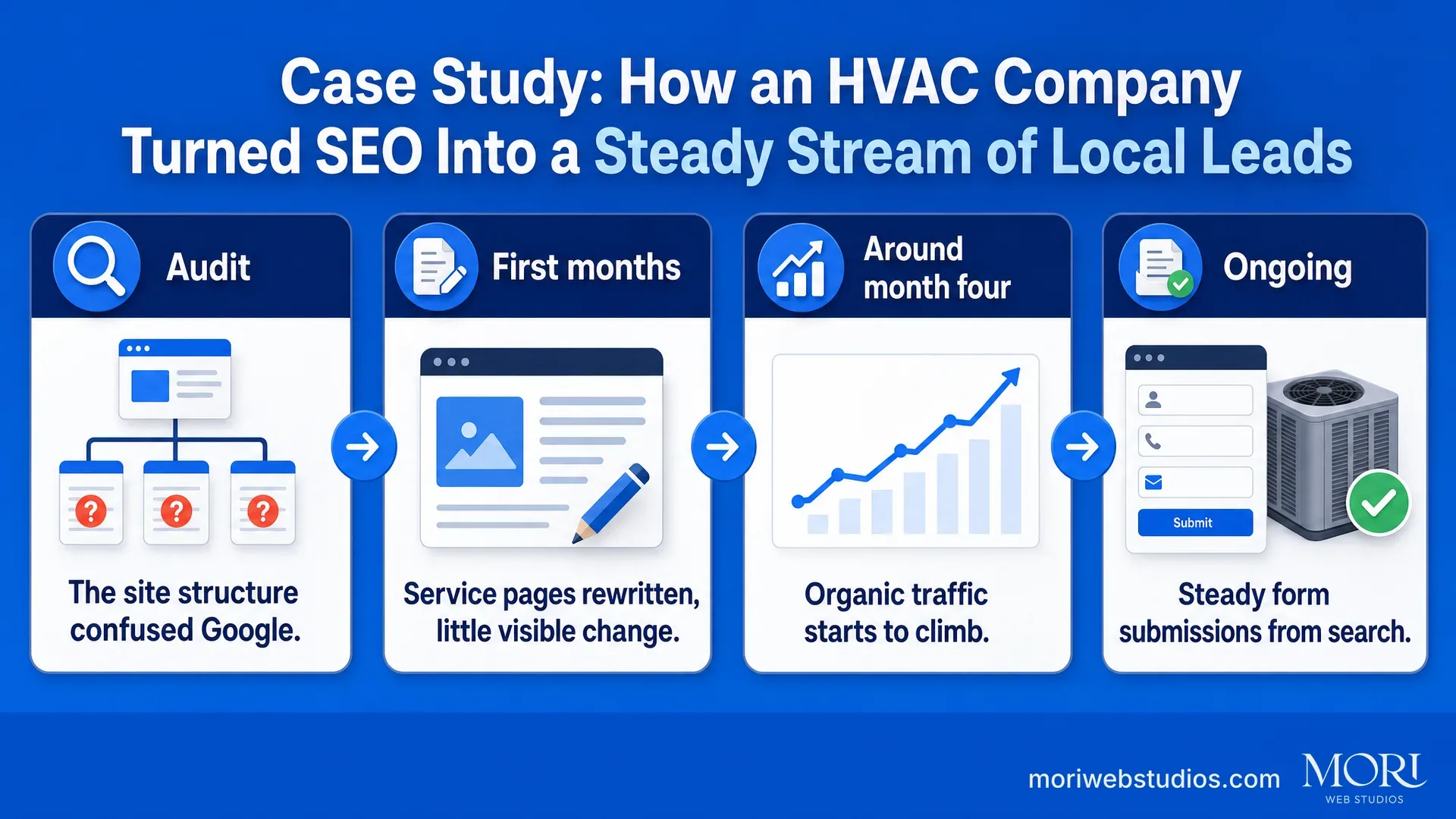
- An honest audit came first. The team identified structural problems.
- Service pages were rewritten with clear headers and accurate meta tags.
- Organic traffic started climbing around month four. The first few months showed little visible change.
- Steady form submissions followed. Leads came from people searching for HVAC services.
- Monthly reports tracked progress, and the team explained the confusing charts.
The Starting Point: A Competitor Was Winning the Local Traffic
HVAC companies lose local search visibility when their websites are built to describe services generally rather than rank for the specific terms homeowners search when a system breaks down.

Daria K., the client whose experience drives this case study, described a frustration many local service business owners recognize immediately. A competitor in her market was showing up consistently for HVAC repair searches while her company was invisible. Prospective customers were finding someone else first.
Why the owner decided to invest in SEO
The decision to invest in HVAC SEO was not impulsive.
She wanted something that could build on itself. That reasoning led her to explore Search Engine Optimization (SEO) as a longer-term channel.
Ranking for HVAC repair searches in a crowded local market
HVAC is a competitive category in most metro areas. Homeowners search with urgency, often on mobile, often when something has already stopped working. Ranking for those searches means your site needs to signal relevance fast and clearly.
According to research on proven HVAC SEO strategies, service-area pages, structured headers, and consistent Google Business Profile signals are among the highest-leverage moves for local contractors.
What the audit found: a site structure that confused Google
Mori Web Studios started with an audit. What it revealed was a site whose structure was confusing Google. The structure was not built to rank.
It was built to exist. That distinction matters more than most business owners realize until they see it on a report.
What Mori Web Studios Changed
The changes were methodical, not scattered. The team fixed the existing service pages first. That sequencing is deliberate, and it reflects how integrating SEO into web design from the ground up produces faster results than patching SEO onto a poorly structured site after the fact.

Rewriting the service page copy
Each service page was rewritten to match the language homeowners use when searching. Vague descriptions like "we handle all your heating and cooling needs" were replaced with specific, location-aware copy that addressed individual services. This is a core principle in step-by-step SEO guidance for HVAC companies: one focused page per service, written for the person searching, not for the technician performing the work.
Adding clear headers and meta tags
They also “added proper headers and meta tags to clean things up.” These are not glamorous changes, but they directly affect whether Google understands what each page is about and whether a user clicks the result in the first place.
Daria’s review specifically called out headers and meta tags as part of what the team addressed, which aligns with what local SEO fixes for HVAC companies consistently identify as quick wins with lasting impact.
Monthly reports that explain the numbers
One detail Daria highlighted was the monthly reports. She found the charts “a bit confusing to read” at times. The team explained what the numbers meant, not just what they were.
For a business owner managing a service company, a report full of impressions data and crawl statistics without context is not useful. Knowing what changed, why it changed, and what comes next is what creates accountability.
The Timeline: Why the First Months Felt Slow
SEO for local service businesses typically shows meaningful organic traffic increases between months three and six, with the strongest compounding visible after six to twelve months of consistent work.
This is the section most business owners need to read before starting. The slow early phase is not a failure signal. It is how search works.
The first few months: little visible change
Daria’s review describes the first months clearly. Not much appeared to be happening on the surface.
This is normal, and expecting otherwise sets up false expectations that lead to premature cancellations. The electrical and HVAC case study from NeedSEO documents a similar pattern: early-phase work is structural, and structural work does not produce overnight ranking spikes.
Around month four: organic traffic starts to climb
Around month four, Daria noticed organic traffic rising. This matches the typical compounding pattern for local HVAC SEO: Google indexes the revised pages, begins to understand the site hierarchy, and starts surfacing results for relevant searches. Month four is not a guarantee, but it is a realistic benchmark for when foundational SEO work begins to register.
Why SEO results take time to compound
Search engines do not rank a page because it was optimized yesterday. They rank it because it has demonstrated relevance, authority, and consistency over time. Each month of content, technical health, and inbound signals builds on the last.
Businesses that cut the engagement at month two or three often abandon an investment that was two months from producing results.
The Results: Steady Form Submissions From Search
The metric that matters most to a service business is not traffic. It is leads. Daria’s review describes steady form submissions arriving from people who found the company through search.
Leads from people who found the business through search
This is the goal of local SEO for HVAC companies: qualified people, in your service area, searching for what you do, finding you first. Those leads cost nothing per click. They do not stop when the budget runs out.
They are the downstream result of months of structural, keyword, and technical work done correctly.
What the client said about the process
Daria called it “kind of a slow process” with “Solid results if you have the patience.” She could see the results in the monthly reports.
And the leads arriving through her contact form were real. That combination, clear process plus visible results plus consistent communication, is what a productive SEO engagement looks like from the client’s side.
Making the reports easier to read
A metric without context is noise. Mori Web Studios sent monthly reports that showed her progress. That kind of reporting builds trust and helps clients make informed decisions about their marketing investment.
If you want to see how that level of transparency applies to your site, the SEO audit resource is a practical first step.
What Other Mori Web Studios Clients Say
Daria’s experience is not an outlier. Other clients on the Mori Web Studios Google Business Profile describe similar themes: responsiveness, follow-through, and results that match what was discussed upfront.
Support that continues after launch
Jakub W. specifically mentioned that ongoing support after launch was a deciding factor. His previous developer had built the site and disappeared, leaving him to manage updates alone. With Mori Web Studios, he described being able to email when something needed to change.
That continuity is part of the website care and optimization service offered to every client.
Website care that keeps sites secure and fast
A fast, secure website is not optional for HVAC leads from organic search. Page speed affects ranking. Security affects trust signals.
Clients who noted the team’s responsiveness were describing something that matters technically: a site that is maintained consistently performs better than one that is launched and left.
Redesigns built around clear communication
Multiple reviewers mentioned that communication was clear from the first conversation. Jenn S. says “they never leave you hanging,” and David S. finished his redesign “weeks ahead of schedule.” For a business owner who has been burned by a disappearing developer, that is not a minor detail.
Lessons for Local Service Businesses
You do not need to be an SEO expert to take the right approach. You need a process that fits how search actually works and a partner who explains it plainly.
Fix the site structure before adding more content
Adding blog posts or new pages to a site with broken hierarchy is like painting walls before fixing the foundation. The audit comes first. Structure comes second.
Content comes third. That sequence is what Mori Web Studios followed with Daria. You can explore more on this topic through the SEO website redesign checklist for SMB owners before making any structural changes.
Give SEO a few months and track it monthly
Commit to a minimum of six months before drawing conclusions. Track month over month using consistent metrics: organic sessions, keyword positions, and form submissions. Month-to-month variation is normal.
The trend line across six months tells you whether the strategy is working.
Ask for reports you can actually understand
If a report requires you to have an SEO background to interpret it, ask for a plain-language summary. What moved? Why?
What is next? Those three questions, answered every month, are enough to stay informed and confident in the engagement.
| Phase | Typical Timeline | What to Expect |
|---|---|---|
| Audit and setup | Month 1 | Site crawl, keyword research, technical fixes |
| On-page optimization | Months 2-3 | Rewritten pages, updated headers and meta tags |
| Early traffic signals | Month 4 | Organic sessions begin to increase |
| Lead conversion | Months 5-6 | Form submissions from search grow steadily |
| Compounding authority | Month 6+ | Rankings stabilize and strengthen over time |
Frequently Asked Questions
How long does HVAC SEO take to show results?
Most HVAC SEO campaigns take three to six months before organic traffic increases meaningfully. The first two months are typically spent on auditing, restructuring, and on-page optimization. Traffic signals begin around month four when Google has indexed the revised pages and started to understand the updated site hierarchy.
Leads from search tend to follow one to two months after traffic begins climbing.
What should an HVAC company fix first on its website?
Start with site structure. Before adding new pages or blog content, make sure each service has its own dedicated page, headers reflect actual search terms, and meta tags describe the page accurately. A site that confuses search engines will not rank regardless of how much content you publish on top of it.
How do monthly SEO reports help an HVAC business owner?
Monthly reports give you a clear view of what changed, why it changed, and what comes next. Tracking organic sessions, keyword positions, and form submissions month over month turns abstract SEO work into a readable trend. If your agency sends reports you cannot interpret without a background in search, ask for a plain-language summary covering those three questions.
What makes HVAC local SEO different from general SEO?
HVAC local SEO marketing focuses on appearing in searches tied to a specific geography: city name, neighborhood, or service area. That means optimizing for terms like "AC repair in [city]" rather than just "AC repair," maintaining an accurate Google Business Profile, and building location-specific service pages. General SEO casts a wider net; local SEO converts the people who are already in your area and ready to call.
Is SEO a better investment than paid ads for an HVAC company?
Both have a place, but they serve different timelines. Paid ads generate visibility immediately and stop the moment the budget does. Organic search builds over time, and the leads it generates do not carry a per-click cost once rankings are established. For HVAC companies looking for sustainable HVAC leads without an indefinite ad spend, SEO is typically the stronger long-term channel.
Many businesses run both in parallel during the ramp-up period.
How much content does an HVAC website actually need?
Depth beats volume. A site with eight well-structured, keyword-aligned service pages will outperform a site with thirty thin posts that all say the same thing. Focus first on one page per service, one page per primary service area, and an accurate homepage that makes the business’s location and specialties immediately clear.
Content can expand from there once the foundation is indexed and ranking.
 Have a project in mind? Share a few details with Mori Web Studios. We’ll help you choose the right next step. Get a free SEO audit |