

If your website gets traffic but not enough leads or sales, the problem is usually not your marketing. It is your funnel. Conversion rate optimization is the process of systematically identifying where visitors drop off and fixing those gaps, so more of the people already visiting your site take the action you want. This guide is written for small and mid-sized business owners who want a practical, step-by-step approach to testing, analyzing, and improving their website conversion funnels without guessing.

Key Takeaways
- Most conversion problems are structural, not traffic-related. Fix the funnel before you spend more on ads.
- Funnel analysis reveals where visitors leave, not just how many do.
- Qualitative tools (heatmaps, session recordings) explain what your analytics numbers cannot.
- Small, focused A/B tests consistently outperform large redesigns in improving conversion rates.
- Ongoing monitoring is what separates businesses that sustain gains from those that plateau.
For more on Key Takeaways, see U.S. Environmental Protection Agency.
What a Conversion Funnel Actually Is
A conversion funnel is the path a visitor takes from first landing on your site to completing a goal: a purchase, a form submission, a phone call, or a booked appointment. Every step between arrival and that goal is a potential drop-off point.
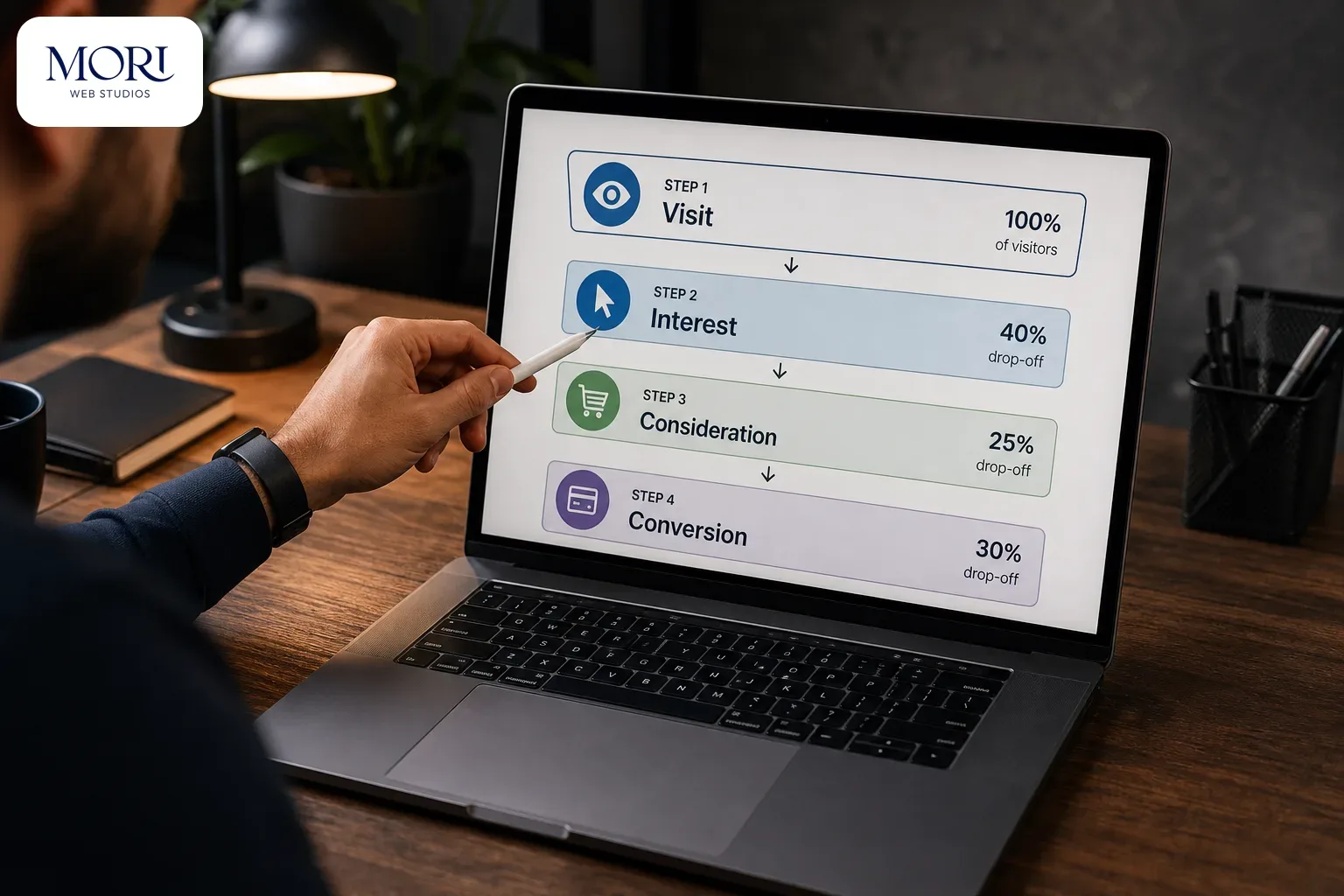
Conversion rate optimization works by reducing friction at each funnel stage so a higher percentage of your existing visitors reach your goal. It is more cost-efficient than acquiring new traffic because you are improving returns from visitors you already have.
Most small business websites have three to five meaningful funnel stages: landing page, product or service page, contact or cart page, and confirmation. Each transition between stages is where you can lose visitors. When working with clients who want better website performance, the funnel is always the first place we look.
Prerequisites: Set Up Before You Test
You cannot fix what you cannot measure. Before you run a single test, make sure these tracking foundations are in place.
| Prerequisite | Tool Options | Why It Matters |
|---|---|---|
| Goal tracking | Google Analytics 4, Plausible | Ties traffic to actual conversions |
| Funnel visualization | GA4 Funnel Exploration, Hotjar | Shows where drop-offs occur |
| Session recordings | Hotjar, Microsoft Clarity | Reveals visitor behavior you cannot see in numbers |
| Heatmaps | Hotjar, Crazy Egg | Shows where users click, scroll, and ignore |
| Form analytics | WPForms, Typeform, Hotjar | Identifies which form fields cause abandonment |
If your site lacks these tools, start by installing Google Analytics 4 and Microsoft Clarity, both of which are free. For more advanced behavioral data, Hotjar’s entry-level plan covers most SMB needs.
A well-structured, responsive website is also a prerequisite. If your site breaks on mobile, your funnel analysis will surface symptoms of a design problem rather than a true conversion issue.
Step-by-Step: How to Find and Fix Funnel Leaks
Follow these steps in order. Skipping ahead to testing before you understand where the problem lives is one of the most common mistakes SMB owners make.
Define Your Primary Conversion Goal
Pick one goal per funnel. If your site has a contact form, a phone number, and a live chat widget, decide which one you are optimizing for right now. Trying to optimize everything at once produces noise, not insight.
Map Your Funnel Stages in GA4
In Google Analytics 4, open the Explore tab and create a Funnel Exploration report. Set each step to match a real page or event in your user journey. For a service business, that might be: Homepage > Services Page > Contact Page > Thank You Page.
Identify Your Biggest Drop-Off Point
Look for the stage with the largest percentage loss. If 80% of visitors leave between your services page and your contact page, that is your priority. Do not start testing your homepage if the contact page is where conversions die.
Gather Qualitative Data on That Stage
Pull session recordings and heatmaps for the page at your biggest drop-off. Look for:
- Rage clicks (users clicking something that is not clickable)
- Dead zones (sections users never scroll to)
- Form abandonment at a specific field
- Calls to action being ignored even when visible
This qualitative layer is what your analytics dashboard misses entirely. Numbers tell you that people leave. Recordings show you why.
Form a Hypothesis
Write a single, testable statement before changing anything. Example: "Visitors leave the contact page because the form asks for too much information upfront. Reducing the form to three fields will increase submissions by at least 10%."
A clear hypothesis keeps your test focused and your results meaningful.
Make One Change and Test It
Change one element at a time. Run an A/B test using a tool like Google Optimize’s successor features in GA4, or a dedicated platform like VWO or Optimizely. Split your traffic so half sees the original and half sees the variation.
Do not declare a winner until you have statistical significance, typically at least 95% confidence. Most SMB tests need two to four weeks of runtime to collect enough data, depending on your traffic volume.
Running Effective Conversion Rate Optimization Tests
Conversion rate optimization testing is not about redesigning your website. It is about making precise, evidence-based changes and measuring the outcome.
| Test Type | Best Used For | Typical Runtime |
|---|---|---|
| A/B Test | Single element changes (CTA, headline, form length) | 2, 4 weeks |
| Multivariate Test | Multiple elements tested simultaneously | 4, 8 weeks, requires high traffic |
| Split URL Test | Entirely different page layouts | 3, 6 weeks |
| User Survey | Understanding intent and objections | Ongoing |
For most SMBs, A/B testing single elements, one at a time, is the most reliable method. High-traffic e-commerce sites can run multivariate tests, but most service businesses do not have enough daily visitors for multivariate results to reach significance quickly.
If you need help with conversion-focused landing pages that are built for testing from the start, that structural foundation makes every future test more reliable.
Common Funnel Problems and How to Fix Them
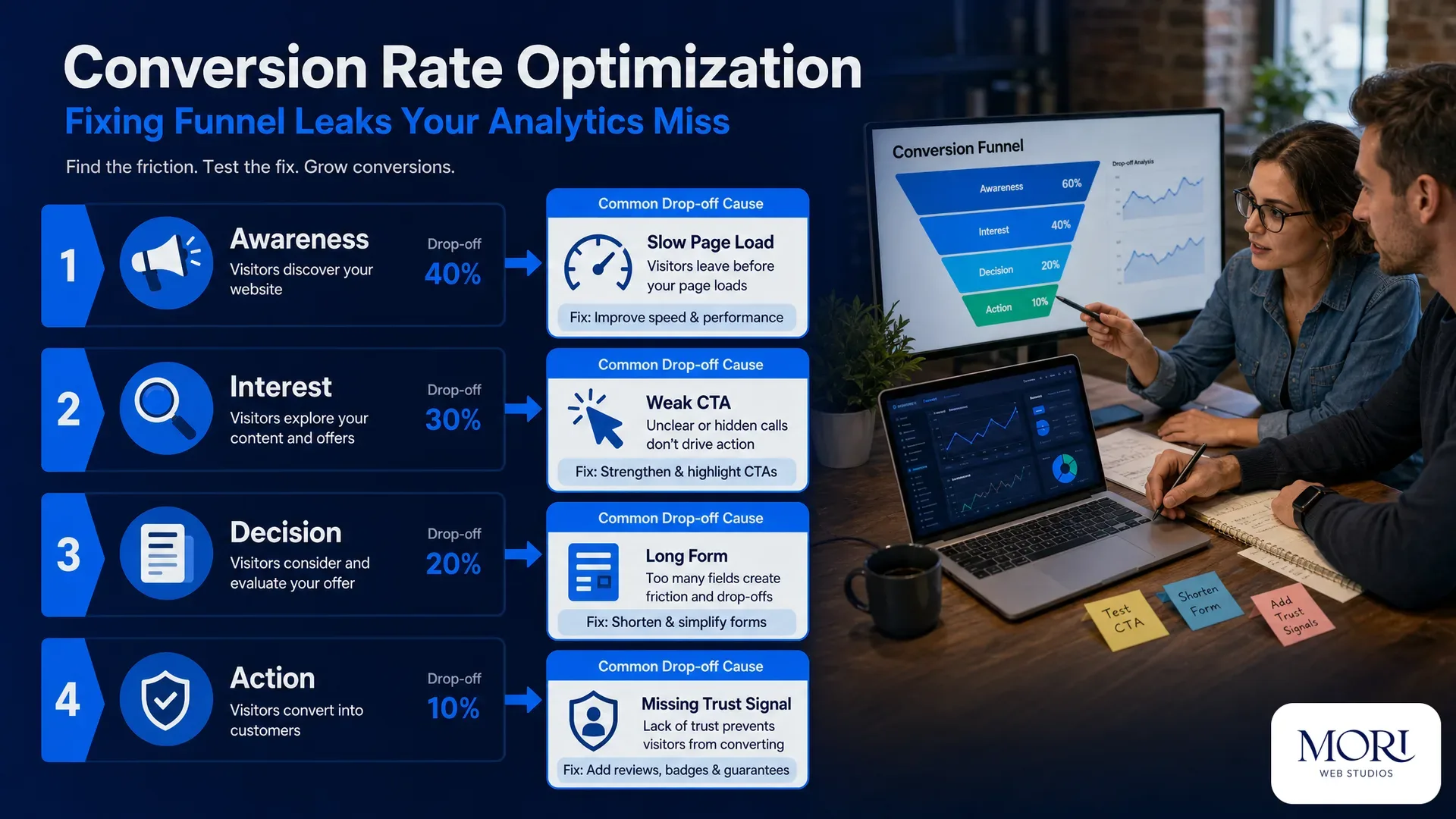
Funnel analysis repeatedly surfaces the same categories of problems. Here are the most common ones and practical fixes.
Weak or buried call to action. Your CTA should be visible without scrolling on desktop and mobile. Use high-contrast color, action-specific language ("Get My Free Quote" beats "Submit"), and place it at least twice on longer pages.
Forms that ask for too much. Every additional field reduces submission rates. For initial contact, ask for name, email, and one qualifying question, nothing more. You can collect additional details once you have the lead.
Missing trust signals. Visitors who do not recognize your brand need social proof before they convert. Add testimonials, a clear address, a phone number, and any relevant credentials near your conversion point. The Federal Trade Commission requires that testimonials reflect genuine customer experiences, so use real, representative reviews rather than composites.
Slow page load speed. A page that takes more than three seconds to load loses a significant share of mobile visitors before they ever see your offer. Compress images, enable caching, and use a reliable host.
Unclear value proposition. If a visitor cannot answer "What does this business do for me?" within five seconds of landing, they will leave. Test different headline variations that lead with the outcome you deliver, not the service you offer.
Tracking Progress and Sustaining Gains
One successful test is not a conversion optimization program. What actually moves the business forward is a continuous cycle of measurement, testing, and iteration.
The businesses that sustain conversion rate gains are the ones that treat optimization as an ongoing practice, not a one-time project.
Build a simple testing log that records your hypothesis, test dates, the variation, the result, and what you decided to implement. After each test, ask what the result tells you about your visitors’ next objection and design your following test around that.
Schedule a monthly review of your funnel metrics. If your conversion rate drops unexpectedly, check for new traffic sources (a surge of unqualified visitors can lower your rate without any change to the page), site errors, or a tracking breakdown. For SMBs that do not have an in-house team to manage this, web care and optimization services provide ongoing monitoring and performance support so the results you earn do not erode quietly over time.
Connecting your funnel performance data to your SEO strategy also matters. If certain search terms bring visitors who convert at twice the rate of others, that insight should shape your content and targeting. Our SEO and GEO services are designed to attract traffic that is already aligned with what your business offers, which makes conversion optimization significantly easier.
How to improve conversion rate performance over time is less about any single tactic and more about building the habit of treating your website as a live asset rather than a finished project.
Frequently Asked Questions
What is a good conversion rate for a small business website?
Conversion rates vary widely by industry and goal type. For service businesses collecting contact form submissions, 2, 5% is a reasonable benchmark to work toward. E-commerce sites typically see 1, 3% purchase conversion rates.
What matters most is your own trend over time, not a comparison to a broad industry average.
How much traffic do I need before conversion rate optimization testing is useful?
You need enough traffic to reach statistical significance within a reasonable timeframe. As a practical guide, aim for at least 500 monthly visitors to the specific page you are testing before running an A/B test. With lower traffic, tests take months to reach significance, and the results are less reliable.
Can I improve conversions without redesigning my website?
Yes. Many of the highest-impact conversion rate optimization changes are small: revising a headline, reducing form fields, adding a testimonial, or making the CTA button more visible. A full redesign is rarely the first step and often the most disruptive one.
How do heatmaps help with funnel analysis?
Heatmaps show you where real visitors click, scroll, and stop engaging on a specific page. This behavioral data reveals problems that session metrics miss, such as a CTA that visitors scroll past without noticing or a navigation element that pulls people away from your conversion path. For a deeper look at site performance tools and what to expect from a professional setup, see what web design services can deliver for your business.
What is the difference between conversion rate optimization and SEO?
SEO focuses on bringing more of the right visitors to your site. Conversion rate optimization focuses on what happens after they arrive. The two disciplines work best together: SEO drives qualified traffic, and a well-optimized funnel turns that traffic into leads or sales.
Investing in one without the other limits your returns. If you want both working in parallel, explore Mori Web Studios’ full solutions for an integrated approach.
How often should I audit my conversion funnel?
A full funnel analysis review every quarter is a reasonable cadence for most SMBs. Outside of scheduled reviews, set up alerts in GA4 for significant drops in goal completions so you catch problems quickly rather than discovering them weeks later during a routine check.
Conclusion
Your website is not a brochure. It is a system, and every step between a visitor arriving and a lead submitting should be earning its place. Conversion rate optimization gives you a structured way to find where that system breaks down and fix it with evidence instead of assumptions.
Start with one funnel, measure it properly, test one change at a time, and build the habit of reviewing results on a regular schedule.
If you want a professional assessment of your current funnel performance or need a website built with conversion in mind from the ground up, contact Mori Web Studios for a strategy call to discuss your goals and the best path forward for your business.