

Most business owners underestimate the role a professional website plays in revenue. 52% of consumers stop using a brand entirely after a single bad experience online, and 52% of website conversions dropped by 6.1% in 2025, putting pressure on every element of your digital presence. Your website isn’t just a digital brochure anymore, it’s your primary sales and credibility tool. The question isn’t whether you need web design services, but whether you can afford to treat your website as an afterthought. Here’s what professional web design services actually deliver and why they matter for your bottom line.
Key Takeaways
- 52% of consumers abandon brands after poor digital experiences, making professional design a direct revenue lever. (2025, Figma)
- Better UX design reduces visitor churn by 4.5x and increases session depth, which correlates to measurable revenue lift.
- The average basic website costs $3,200, but checkout and conversion optimization can deliver 35% conversion rate increases for e-commerce sites.
- The Web Design Process: From initial discovery through launch, expect 4-8 weeks of collaboration, research, design iterations, and testing to ensure your site meets business goals.
- Why Professional Design Matters: Sites built by professionals deliver higher conversions, better accessibility, and stronger brand trust than templates or DIY approaches.
- Design Components Worth Investing In: Strategic navigation, mobile responsiveness, conversion funnels, and accessibility all directly impact business outcomes.
- Measuring Success: Track conversion rates, bounce rates, session depth, and engagement metrics tied to business objectives, not vanity numbers.
- Ongoing Optimization: Web design doesn’t end at launch; maintenance, updates, and performance optimization ensure sustained results.
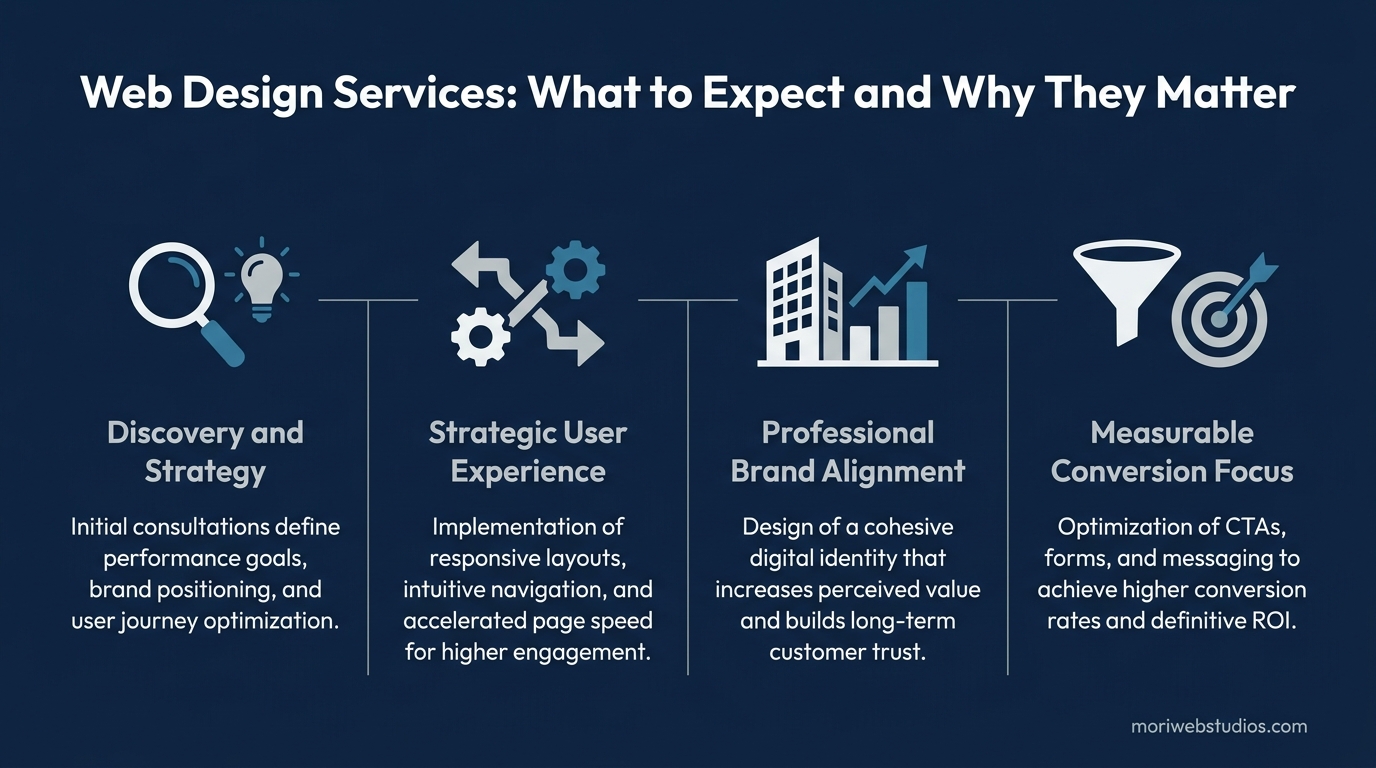
The Web Design Process: What Happens Behind the Scenes
Professional web design services follow a structured methodology that ensures your website aligns with business goals, serves your target audience, and performs under real-world conditions. Most agencies follow similar phases: discovery, strategy, design, development, testing, and launch. Understanding each phase helps you anticipate timelines, contribute at the right moments, and make decisions that stick.
Discovery and Initial Consultation
The first phase sets everything else in motion. During discovery, your web designer asks the critical questions most business owners never fully answer: What’s the purpose of this website? Who visits it? What do you want them to do? According to research from Figma’s web design statistics, companies that validated user research and usability testing were 1.9x more likely to report improved customer satisfaction than those making design decisions without input. A proper discovery session typically covers business goals, target audience definition, competitive landscape analysis, and success metrics.
“A proper discovery session separates websites that convert from those that merely exist. The precision you invest in defining success metrics during discovery directly determines whether your final site generates ROI or just traffic.”
— Strategic Web Design Best Practice
Expect your web designer to dig into specifics. Don’t settle for vague answers like “increase online visibility.” Instead, define measurable outcomes: lead generation targets, e-commerce conversion rates, content engagement benchmarks, or customer inquiries. The more precise you are during discovery, the more targeted the design becomes. This is where Mori Web Studios begins every consultation, ensuring strategy drives every subsequent decision.
Information Architecture and Wireframing
Once goals are clear, designers map out how information flows through your site. This stage produces wireframes, which are skeletal layouts showing page structure, navigation hierarchy, and content placement without visual design. Wireframes ensure the user journey makes sense before you invest in visuals. You’ll see where forms go, how many navigation levels exist, and which calls-to-action appear where.
This is where you catch structural problems early. Can visitors find what they need in three clicks? Is the conversion path obvious? Does the mobile layout still make sense when screens shrink? Addressing these at wireframe stage costs far less than rebuilding after visual design is complete.
Visual Design and Brand Application
Once structure is solid, the designer creates mockups showing color, typography, imagery, and overall visual identity. If you’re building a brand from scratch, this phase includes logo concepts, color palette development, and font selection. This is where your website begins to feel like your business. Expect 2-3 rounds of feedback and refinement. The designer will adjust layouts, color combinations, and visual hierarchy based on your input and usability principles. Brand consistency matters, and professional branding services ensure your visual identity works across web, print, and digital marketing.
Why Professional Web Design Directly Impacts Revenue

Poor website design isn’t a minor inconvenience, it’s a revenue leak. When acquisition costs rose by 9% in 2025, inefficient websites became even more expensive to operate. Professional design reduces friction at every step, from initial impression to final conversion. Sites that minimize user frustration see 4.5x less visitor churn. According to Clutch’s web design statistics, accessibility improvements alone deliver revenue benefits for 75% of organizations that prioritize them. These aren’t soft metrics; they’re business outcomes.
Conversion Optimization and User Experience
The checkout page is where most e-commerce revenue lives, yet it’s often designed last or outsourced without strategic thought. E-commerce sites optimized for checkout design see 35% conversion rate increases. A few extra form fields, confusing error messages, or unclear shipping costs can destroy conversions. Professional designers know these patterns. They design checkout flows to reduce friction, eliminate unnecessary fields, build trust with security signals, and guide customers toward completion.
“Every additional form field, every unclear error message, and every moment of checkout friction directly reduces revenue. Professional designers obsess over these micro-interactions because they compound into measurable conversion loss or gain.”
— E-Commerce Conversion Optimization Research
The same applies to lead generation sites. A poorly positioned contact form, unclear value proposition, or broken mobile experience kills inquiries. Professional designers test every interaction, every button placement, every form field to ensure visitors actually complete the action you want them to take.
Mobile Responsiveness and Accessibility
Over 60% of web traffic comes from mobile devices, yet many websites still aren’t optimized for mobile-first experiences. Professional web design services build responsive designs that work flawlessly on phones, tablets, and desktops. More than that, accessibility in modern web design isn’t optional, it’s essential. Organizations prioritizing accessibility as a business lever report direct revenue benefits, and search engines now reward accessible sites in rankings.
Accessibility includes readable font sizes, sufficient color contrast, keyboard navigation, alt text for images, and semantic HTML structure. These elements help both assistive technology users and search engines understand your content. Mori Web Studios integrates accessibility standards into every project, ensuring your site reaches wider audiences and ranks better in search.
Brand Trust and First Impressions
Users judge your site’s credibility in milliseconds. Outdated design, slow load times, broken links, and poor layout signal that your business isn’t trustworthy. Professional design builds confidence. Clear navigation, polished visuals, fast load speeds, and mobile optimization tell visitors you’re serious about serving them. When customers research you online, your website is often the deciding factor between choosing you or a competitor.
Key Components of Professional Web Design Services

Not all web design services are the same. Strategic agencies offer integrated services that go beyond aesthetics. Here’s what separates professional services from template-based or DIY approaches:
Strategic Planning and Goals Alignment
This is where professional agencies add immediate value. Before drawing a single pixel, strategy work defines success. You’ll identify your primary conversion goal, secondary goals, target audience segments, competitive positioning, and success metrics. Strategy unifies every design decision around measurable outcomes. Without it, the designer is flying blind, creating pretty websites that don’t move the needle on revenue.
A proper strategic consultation also includes technical SEO recommendations. Your designer should understand how site structure affects search visibility, where keyword placement matters, and how URL hierarchy influences rankings. Sites designed in isolation from SEO strategy miss opportunities to rank for high-intent search terms, costing you organic visibility and leads. When you work with an agency that specializes in both design and SEO, like Mori Web Studios’s integrated SEO services, your website launches optimized for both users and search engines.
Content Strategy and Messaging Architecture
Your website needs to speak to your audience’s pain points, not list your product features. Content strategy defines messaging hierarchy, tone, key value propositions, and audience-specific language. Professional designers ensure content doesn’t just fill pages; it guides visitors toward decisions. When your visitor lands on your site, they should immediately understand what you do, why it matters to them, and what action to take next.
“Content strategy separates websites that inform from websites that convert. The most effective sites don’t tell your business story—they solve your visitor’s problem and explain why you’re the best solution.”
— Content-Driven Conversion Strategy
This phase also identifies content gaps. Many businesses think they need massive amounts of content when in reality, focused, high-impact messaging converts better. A professional content strategy eliminates waste and targets high-converting pages.
Technical Development and Performance Optimization
Behind every polished design is technical foundation that can make or break user experience. Professional web design includes clean code, fast load times, proper security setup, mobile optimization, and search engine optimization. A beautifully designed site that loads slowly or breaks on mobile fails its purpose. Technical developers ensure your website meets performance standards, security requirements, and platform best practices.
This also includes integrations with your CRM, email marketing platform, analytics tools, and business systems. When your website talks to your business infrastructure, you capture leads, track performance, and scale operations.
How to Choose the Right Web Design Service Provider

Not all web design agencies deliver the same results. SMBs in New York and surrounding regions need partners who understand local market dynamics, can communicate business value clearly, and deliver measurable outcomes. Here’s what to evaluate:
Portfolio and Case Studies
Ask to see completed projects, ideally in your industry or serving similar audiences. Don’t just look at aesthetics; ask what business problems each site solved. Did it increase conversions? Generate leads? Improve search rankings? Real portfolio work shows tangible outcomes. Mori Web Studios publishes detailed case studies documenting the strategy, process, and measurable results for each client project, so you can evaluate the actual impact before committing.
Team Expertise and Specialization
Ask who builds your site. Will you work with the agency that sold you, or does the project get handed off to junior developers? The best agencies have dedicated teams with specific expertise: strategists, designers, developers, SEO specialists, and project managers. Each role matters. When multiple experts collaborate, you get better results than a solo freelancer trying to do everything.
Look for specialization, too. Does the agency understand e-commerce? SaaS? Local services? Your industry’s specific needs matter. An agency specializing in web design for professional services and local businesses (like Mori Web Studios’s web design and development services) will design differently than one optimizing for retail fashion sites.
Ongoing Support and Maintenance
Web design isn’t a one-time project; it’s the beginning of an ongoing relationship. After launch, websites need updates, security patches, performance monitoring, and optimization. Ask what happens after your site goes live. Does the agency provide hosting? Updates? Performance monitoring? Technical support? The best agencies offer comprehensive web care packages that keep your site running smoothly and continuously optimized. Services like web care optimization ensure your site remains fast, secure, and search-friendly long after the initial launch.
Investment and ROI for Web Design Services
What should you expect to pay for professional web design? The answer depends on scope, complexity, and your market. The average cost to create a basic website is $3,200, but custom design, e-commerce functionality, content migration, and SEO setup typically add to that baseline. A full-featured website for a small business typically ranges from $5,000 to $15,000, while enterprise sites can exceed $50,000.
Calculating Web Design ROI
The real question isn’t cost, it’s return. If a better website increases conversion rates by 10%, how much additional revenue does that generate? If it reduces acquisition costs by improving organic search traffic, what’s the savings over 12 months? Professional web design ROI should be measured in:
- Conversion Rate Lift: Even a 2-3% improvement in conversion rates can double ROI on design investment within a year.
- Acquisition Cost Reduction: Better organic search visibility reduces paid advertising spend.
- Customer Lifetime Value Increase: Professional sites build trust, improving customer retention.
- Lead Quality Improvement: Proper qualification and nurturing on your website filters out poor-fit leads, improving sales efficiency.
- Reduced Support Costs: Clear navigation and intuitive design reduce customer support inquiries.
When evaluating a proposal, ask the agency to help you estimate potential ROI. Good agencies can point to industry benchmarks and comparable client outcomes. If they can’t articulate business value, that’s a red flag.
Comparing Website Design Services
When evaluating options, you’ll encounter different service models:
| Service Type | Timeline | Customization | Best For | ROI Potential |
|---|---|---|---|---|
| Template-Based Design | 2-4 weeks | Low (limited modifications) | Budget-conscious startups with simple needs | Moderate (limited optimization) |
| Semi-Custom Design | 4-6 weeks | Medium (template with custom elements) | SMBs needing professional appearance without full custom build | Good (responsive, basic SEO) |
| Fully Custom Strategic Design (Mori Web Studios) | 8-12 weeks | High (designed entirely for your business) | Growing companies needing competitive advantage and measurable results | Highest (strategy-driven, optimization-focused) |
| DIY/No-Code Tools | 6-12 weeks | Medium (user-controlled customization) | Businesses with design skills and time | Low (limited functionality, poor SEO) |
For SMBs in New York seeking to improve visibility and generate qualified leads, fully custom strategic design delivers the highest ROI. Templates look fine initially but lack the specificity and optimization that drives conversions. Mori Web Studios’s approach combines professional design, strategic planning, and ongoing optimization to ensure your website becomes a revenue-generating asset, not just a digital business card.
The Web Design Roadmap After Launch
The website launch date isn’t an ending, it’s a beginning. Successful digital strategies include post-launch optimization and continuous improvement. This is where many businesses fail by going dark after their site launches.
Performance Monitoring and Data Analysis
Within the first 30 days of launch, monitor core metrics: page load speed, mobile usability, organic search impressions, click-through rates from search results, and conversion rates. Set up Google Analytics 4, Google Search Console, and conversion tracking. You won’t see the full impact of your new site for 3-6 months, but early data informs optimization priorities.
Track session depth, bounce rates, and user behavior on high-value pages. If visitors leave immediately from your pricing page, that page needs refinement. If your contact form has a 30% abandonment rate, something in the form flow breaks the user experience.
Iterative Optimization and Content Updates
After launch, schedule quarterly reviews to evaluate performance against goals. Run A/B tests on high-impact pages. Refine messaging based on what resonates. Update case studies, testimonials, and blog content to keep your site fresh. Search engines favor regularly updated sites, and visitors trust sites showing current information.
Optimization is ongoing. Small improvements compound: a 5% conversion rate increase on your homepage, combined with a 10% reduction in bounce rate on your services page, combined with better search rankings for high-intent keywords, creates compounding revenue growth over 12 months.
Conclusion
Professional web design services solve the core problem most business owners face: a website that looks fine but doesn’t generate results. When 52% of consumers abandon brands after poor digital experiences and conversion rates dropped 6.1% in 2025, your website’s performance directly impacts revenue. Professional agencies apply strategy, design expertise, technical development, and optimization to build sites that convert visitors into customers and generate measurable business outcomes.
The right web design partner understands your industry, communicates in business terms, collaborates throughout the process, and remains invested in your success after launch. If you’re looking to build or redesign your website with a focus on strategy, conversion optimization, and measurable results, contact Mori Web Studios to discuss your goals and explore the best path forward for your business.
FAQs
How long does it take to design and build a professional website?
A fully custom professional website typically takes 8-12 weeks from initial discovery through launch. This timeline includes discovery and strategy (1-2 weeks), design and iteration (3-4 weeks), development and integration (3-4 weeks), testing and optimization (1-2 weeks), and final refinement. Simpler sites or template-based designs may launch faster, but rushed timelines often sacrifice strategy and optimization, leading to lower-performing sites. The investment in thorough process almost always delivers better results than shortcuts. Timeline varies based on project complexity, the number of pages, content requirements, and your feedback responsiveness.
What’s the actual cost of professional web design services?
A basic professional website averages $3,200 to $8,000, while more complex sites with e-commerce, custom functionality, or extensive content integration range from $10,000 to $25,000 or higher. Cost depends on scope, features, integrations, and ongoing support. Rather than comparing absolute price, evaluate ROI: if a $12,000 website increases conversion rates by 5%, the payoff within 6-12 months justifies the investment. Ask your provider for ROI projections based on comparable clients’ results and industry benchmarks. Cheap sites often end up costing more when they require rebuilds or fail to generate business results.
How do I know if my new website is performing well?
Track metrics tied to business outcomes, not vanity numbers. Measure conversion rate (visitors who complete your target action), bounce rate (visitors who leave immediately), average session duration (how long people stay), and search rankings for your target keywords. If your website is designed to generate leads, monitor lead quantity and quality. If it’s an e-commerce site, track cart abandonment rate and average order value. Set up Google Analytics 4 to capture this data, review performance monthly, and adjust content and design based on what’s working. Most professional websites reach full performance potential 3-6 months after launch as organic search improves and you refine messaging based on actual user behavior.